
California AB 1263 Explained: What Firearm Owners and Estate Sellers Need to Know
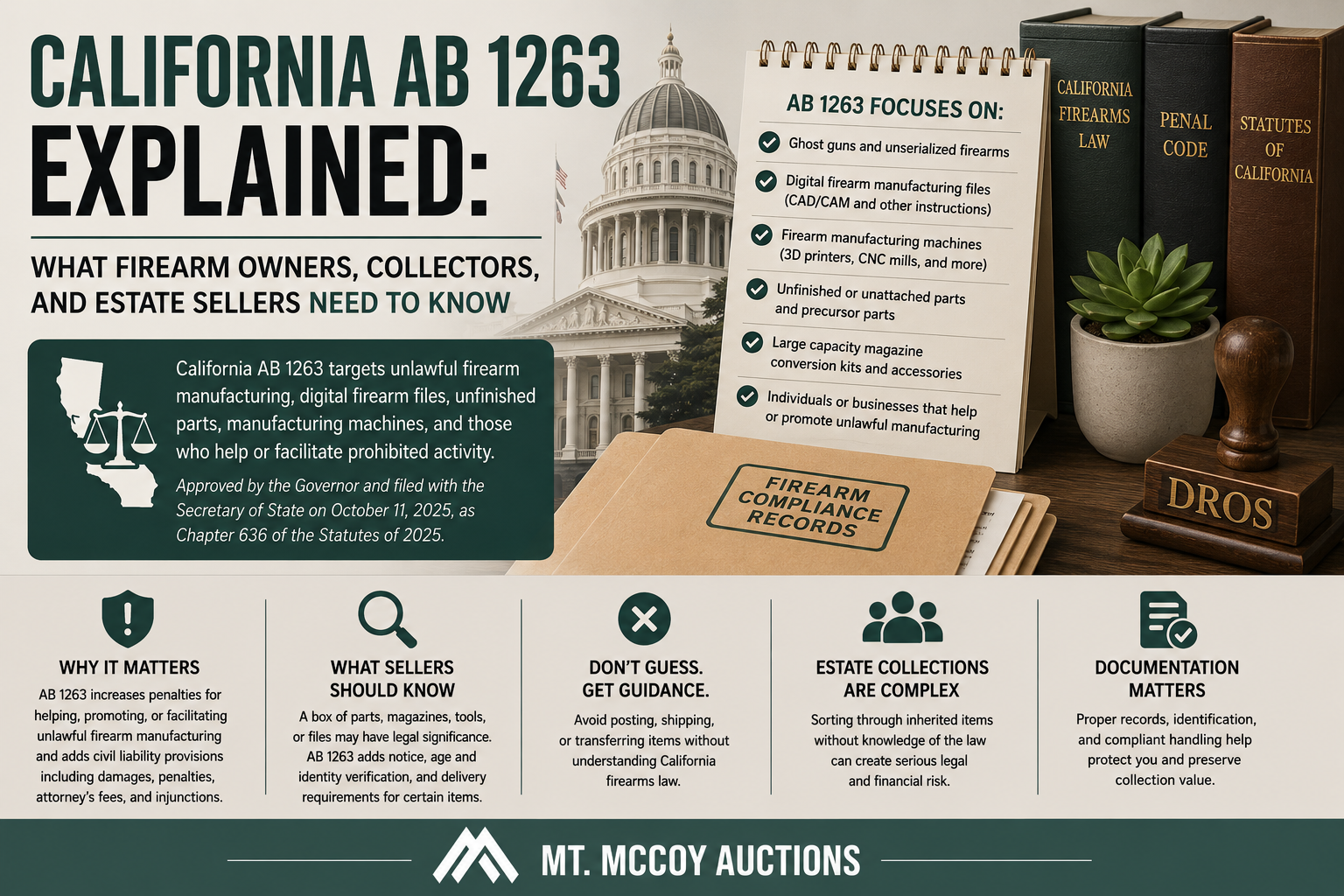
California AB 1263 is a firearms law focused on what the state defines as unlawful firearm manufacturing, including so called “ghost guns,” digital firearm manufacturing files, unfinished firearm components, firearm manufacturing machines, and certain activities connected to homemade firearms.
The bill was approved by the Governor and filed with the California Secretary of State on October 11, 2025, as Chapter 636 of the Statutes of 2025.
For many people, especially those who inherit firearms or firearm related items, the law can become confusing quickly. Terms such as “precursor part,” “digital firearm manufacturing code,” “CNC milling machine,” or “large capacity magazine conversion kit” are not language most ordinary estate sellers encounter in daily life.
The practical takeaway is simple: California is placing greater responsibility and scrutiny on individuals and businesses connected to homemade firearms, firearm manufacturing tools, digital gun files, unfinished components, and certain regulated accessories.
Why California AB 1263 Matters for Estate Sellers and Families
Many inherited firearm collections contain more than just traditional rifles or handguns. Families often discover safes, storage bins, parts kits, magazines, barrels, tools, ammunition, printed components, or unidentified firearm related items that the original owner accumulated over decades.
The challenge is that many heirs are not firearm experts. They may not know:
what is legally transferable
what requires documentation
what may be restricted under California law
what has collector value
what could create legal issues if handled incorrectly
AB 1263 increases the importance of understanding exactly what is in a collection before attempting to sell, transfer, ship, or dispose of items casually.
The law expands penalties related to helping, facilitating, promoting, or participating in unlawful firearm manufacturing activities. It also creates additional civil liability exposure in certain circumstances, including actions involving damages, attorney’s fees, penalties, and injunctions.
What California AB 1263 Actually Targets
AB 1263 is not primarily aimed at ordinary individuals lawfully selling a standard hunting rifle, revolver, shotgun, or inherited firearm collection through licensed channels.
Instead, the legislation focuses largely on unlawful firearm manufacturing activities, including:
manufacturing firearms with 3D printers or CNC machines without proper licensing
manufacturing multiple firearms without required licenses
producing firearms intended for unlawful transfer
manufacturing prohibited firearms or regulated weapons
distributing or facilitating certain digital firearm manufacturing files
activities connected to unserialized firearms or prohibited firearm components
The bill also expands California’s definition of “digital firearm manufacturing code” to include certain computer aided design files, computer aided manufacturing files, and digital instructions capable of assisting in the production of firearms, frames, receivers, precursor parts, magazines, and other regulated items.
In practical terms, the law reaches beyond complete firearms themselves and increasingly focuses on the surrounding ecosystem of files, parts, accessories, tools, and manufacturing equipment.
Why This Can Become Confusing Quickly
One of the biggest problems for estate sellers is that many regulated or potentially restricted items do not immediately look important.
A box of miscellaneous “gun parts” may actually contain:
unfinished receivers
barrels
jigs
magazines
conversion components
printed parts
manufacturing tools
regulated accessories
To someone unfamiliar with California firearms law, these items may appear harmless or insignificant. However, some items can carry additional legal considerations depending on how they are configured, transferred, advertised, or shipped.
AB 1263 also introduces additional notice, identity verification, and delivery related requirements involving certain firearm barrels, firearm accessories, and firearm manufacturing machines in some situations involving firearm industry members.
That is why attempting to sort everything independently using internet searches or online forum advice can become risky very quickly.
What Sellers Should Be Careful About
If you are helping manage an estate or inherited firearm collection, one of the safest first steps is slowing the process down.
Do not assume every item is simply ordinary “gun stuff.” More importantly:
do not casually post unidentified items online
do not ship firearm related parts without understanding applicable laws
do not assume older or unfinished items are automatically exempt
do not rely entirely on social media or forum opinions
do not attempt informal transfers without understanding California requirements
Proper inventory, documentation, identification, and professional review can help avoid unnecessary mistakes.
Collectors should also remember that California firearm laws continue to evolve through legislation, regulatory interpretation, and ongoing litigation. What was commonly accepted years ago may now be regulated differently.
How Mt. McCoy Auctions Helps
This is where working with an experienced firearms auction and consignment company becomes valuable.
Mt. McCoy Auctions helps sellers identify what they actually have, separate ordinary firearms from specialized or potentially restricted items, organize collections, document condition and details, photograph items professionally, and help route transfers through the appropriate process.
For many families, the hardest part is simply understanding where to begin.
An inherited collection may contain:
collectible firearms
antiques
modern sporting rifles
magazines
parts
accessories
ammunition
historical items
unidentified firearm related components
Most estate sellers are not firearms experts, nor should they be expected to become experts overnight. Mt. McCoy Auctions helps create a more organized, transparent, and compliant process while helping families better understand the collections they inherited.
Bottom Line
California AB 1263 is another reminder that firearm related collections in California should not be handled casually, especially when an estate includes parts, accessories, unfinished components, magazines, tools, or items that are difficult to identify.
The safest approach is usually to slow down, document the collection carefully, avoid guessing, and work with experienced professionals who understand both the collector market and the regulatory landscape.
For families handling inherited firearms, knowledgeable guidance can make an overwhelming situation significantly more manageable from the start.
Resources & Further Reading
California Legislative Information Portal – AB 1263 Bill Text
https://leginfo.legislature.ca.gov/faces/billNavClient.xhtml?bill_id=202520260AB1263
LegiScan – California AB 1263 Overview and History
https://legiscan.com/CA/text/AB1263/id/3272861
California Department of Justice – Firearms Information Portal
https://oag.ca.gov/firearms
California Department of Justice – Personal Firearms Eligibility Check
https://oag.ca.gov/firearms/pfecfaqs
California Department of Justice – Firearm Ownership Report Information
https://oag.ca.gov/firearms/pubfaqs
Bureau of Alcohol, Tobacco, Firearms and Explosives (ATF)
https://www.atf.gov/firearms
National Shooting Sports Foundation (NSSF) – California Firearm Laws & Regulations
https://www.nssf.org/government-relations/state-action-center/california/
Gun Owners of California
https://gunownersca.com/
California Rifle & Pistol Association (CRPA)
https://crpa.org/
Mt. McCoy Auctions
https://mtmccoyauctions.com/
Disclaimer
This article is for general educational purposes only and is not legal advice. Firearm laws and regulations change frequently, and individual situations vary. Always consult a qualified attorney or licensed firearms professional regarding specific legal or compliance questions.
The resources listed above are provided for informational purposes only and should not be interpreted as legal guidance or endorsements.

