
California AB 1078 Explained: What Collectors, Estate Sellers, and Buyers Need to Know About California’s “3 in 30” Firearm Purchase Rule
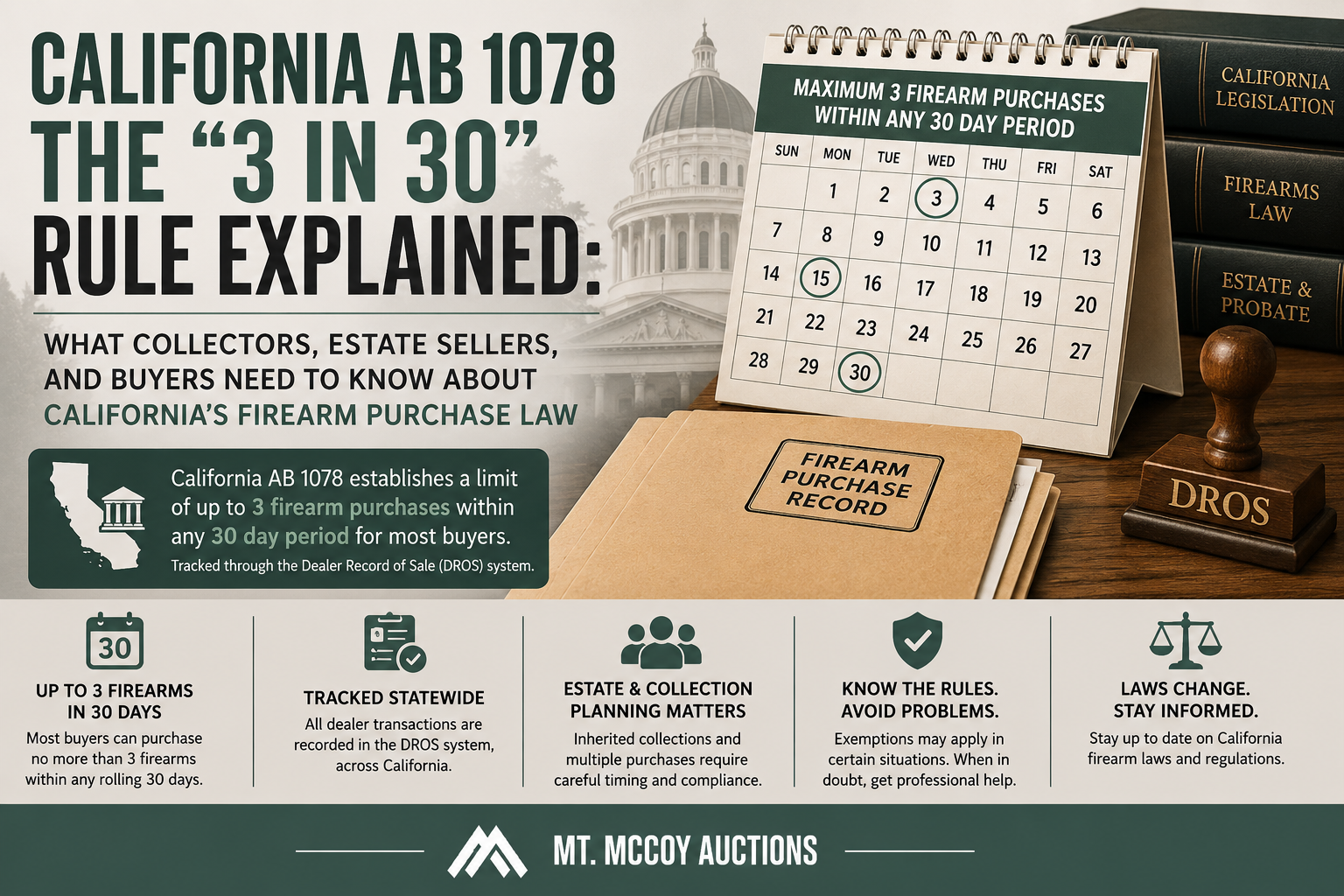
California firearm laws continue to evolve, and one of the more talked about recent changes is the state’s move from the old “1 in 30” firearm purchase restriction toward what many now refer to as the “3 in 30” rule. For collectors, estate sellers, heirs, and everyday firearm owners, the change has created both confusion and questions about what is actually allowed under California law.
While the update may sound straightforward at first, the practical impact can become complicated quickly, especially when multiple firearms, inherited collections, auction consignments, or dealer transfers are involved.
What Is California AB 1078 and the “3 in 30” Rule?
California historically enforced what was commonly called the “1 in 30” rule, which generally limited firearm purchasers to acquiring one firearm within any 30 day period through dealer transactions. That restriction became the subject of legal challenges in federal court, including Nguyen v. Bonta.
Following ongoing litigation surrounding the older restriction, California lawmakers introduced updated legislation commonly referred to as the “3 in 30” bill through AB 1078. In practical terms, the law allows most eligible purchasers to acquire up to three firearms within a 30 day window instead of only one.
The law still relies on California’s Dealer Record of Sale (DROS) system, meaning purchases are tracked through licensed dealer transactions statewide.
Why This Matters for Collectors and Estate Sellers
For someone casually purchasing a single hunting rifle or handgun, the change may not seem significant. However, the situation becomes far more important when collections, estates, or multiple transactions are involved.
Many people inherit several firearms at once after the death of a family member. Others discover collections stored in safes, garages, or storage units and assume they can immediately sell, transfer, or distribute everything without issue. California law is rarely that simple.
Questions that often arise include:
Does the limit apply to private party transfers?
What happens if multiple firearms are purchased at auction?
Are consignment sales affected?
How do dealer processing timelines impact transfers?
Do exemptions apply for collectors or certain licenses?
What if family members are involved?
For many people, the hardest part is not the law itself, but understanding how different California firearm regulations interact together.
What California AB 1078 Actually Restricts
The “3 in 30” rule generally focuses on dealer processed firearm purchases and deliveries within a rolling 30 day period. In simple terms, most buyers cannot complete more than three qualifying firearm purchases during that timeframe.
The exact application of the law can vary depending on:
the type of firearm
the transaction structure
whether exemptions apply
whether the firearm is part of an estate transfer
the buyer’s licensing status
ongoing litigation and regulatory interpretation
Importantly, this law does not mean Californians can ignore other transfer rules, waiting periods, background checks, or compliance requirements. The state still requires most firearm transactions to move through licensed dealers and the DROS system.
Why Estate Collections Create Confusion
Estate situations are where California firearm law often becomes especially overwhelming for families.
A surviving spouse, child, executor, or trustee may suddenly find themselves responsible for:
multiple firearms
ammunition
magazines
accessories
paperwork
safes
historical collectibles
regulated modern firearms
Many heirs are not firearm experts. They may not know what is legally transferable, what has collector value, what requires documentation, or what restrictions apply under California law.
The “3 in 30” framework adds another layer of complexity because transfer timing and dealer processing can matter more than people realize. Trying to rush transactions or “figure it out later” can create unnecessary problems.
What Buyers and Sellers Should Be Careful About
One of the biggest mistakes people make is assuming all firearms are treated the same under California law. They are not.
Another common mistake is relying entirely on internet forums or secondhand advice without understanding how California dealer processing actually works.
If you are dealing with an inherited collection or multiple firearm transactions, it is wise to:
slow down
inventory the collection carefully
document items properly
avoid informal transfers
avoid shipping firearms casually
work through licensed and knowledgeable channels
Collectors should also remember that laws can change while litigation continues. California firearm regulations are frequently updated, challenged, revised, or reinterpreted through court decisions and new legislation.
How Mt. McCoy Auctions Helps
This is where experienced auction and consignment support becomes valuable.
Mt. McCoy Auctions helps sellers navigate collections that may otherwise feel overwhelming, especially after a death in the family or during a major estate transition. That includes helping identify firearms, organizing consignments, documenting items, photographing collections, and helping route transactions through the appropriate licensed process.
For many families, the biggest benefit is simply having knowledgeable guidance during a stressful and unfamiliar situation.
A collection may include:
collectible historical firearms
modern sporting rifles
hunting shotguns
revolvers
antiques
accessories
magazines
ammunition
items with significant collector value
Understanding what you have before making decisions matters. Proper organization and compliant handling can help avoid confusion, preserve value, and create a smoother process for everyone involved.
Bottom Line
California AB 1078 and the state’s “3 in 30” firearm purchase framework are reminders that firearm transactions in California are rarely as simple as many people expect. While the law may appear straightforward on paper, collections, estates, dealer processing, and exemptions can quickly complicate matters.
For families handling inherited firearms, collectors managing large collections, or sellers preparing consignments, the smartest approach is usually to slow down, document everything carefully, and work with experienced professionals who understand both the market and the compliance landscape.
Helpful Resources
California Legislative Information
https://leginfo.legislature.ca.gov/
California Department of Justice Firearms Information
https://oag.ca.gov/firearms
Bureau of Alcohol, Tobacco, Firearms and Explosives
https://www.atf.gov/
Mt. McCoy Auctions
https://mtmccoyauctions.com/
Disclaimer
This article is for general educational purposes only and is not legal advice. Firearm laws change frequently, and individual situations vary. Consult a qualified attorney or licensed firearms professional regarding your specific circumstances.

